
North Central College Convenes Expert Panel to Discuss Impact of AI on Education and Workforce
Feb 18, 2026
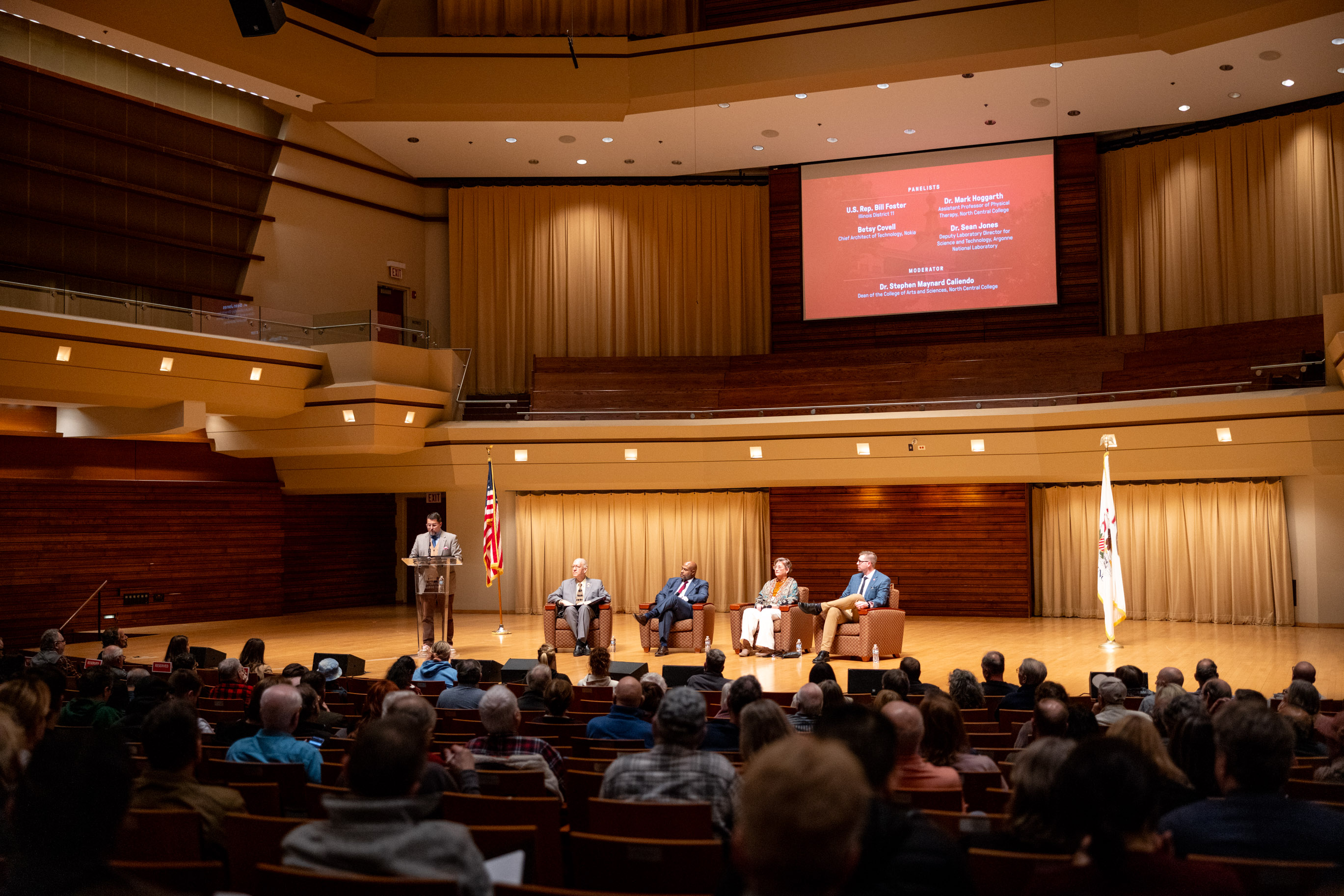
North Central College co-hosted a panel discussion about artificial intelligence (AI) and its impact on education and the workforce on February 16 in the College’s Wentz Concert Hall. The event was held in partnership with U.S. Rep. Bill Foster, whose Congressional district (IL-11) includes the North Central College campus.
In addition to Congressman Foster, panelists included Dr. Sean Jones, deputy laboratory director for science and technology at Argonne National Laboratory; Betsy Covell, chief architect of technology at Nokia; and Dr. Mark Hoggarth, assistant professor of physical therapy at North Central College. The panel was moderated by Dr. Stephen Maynard Caliendo, dean of the College of Arts and Sciences and professor of political science at North Central College.
In his welcoming remarks, North Central College President Abiodun Goke-Pariola said, “We, like many of you, are grappling with uncomfortable questions around the use of AI. As an educational institution, the first thing we must do is to avoid jumping into the fray, and instead — to think, ask questions, and do our research, and then determine the best path forward for us. Above all, we must ensure that our students can go out into the world competent and knowledgeable about AI, and hopefully with an extra dimension of ethical responsibility in its use and deployment.”
Foster, a PhD physicist who worked at Fermi National Accelerator Laboratory (Fermilab) before becoming a member of Congress, recalled working on early versions of AI at Fermilab decades ago. He said: “I want to thank North Central College and everyone involved in this. This is a really important and timely discussion and a great place to have it.”
The panel covered a wide range of AI-related topics, including policy and regulation, ways in which AI is changing various fields of work and study, the impact of AI on health care and the patient experience, as well as gaps in AI access, barriers to adoption, and the importance of diversity in AI development.
Specific to higher education, Caliendo asked the panel to share what they think colleges and universities should do with AI to help students not only transition into the workforce, but to maintain the type of society that we want to live in.
“I’d like to see every student learn about AI, because it’s a tool that can be used in many ways – ways that are both appropriate and inappropriate,” said Covell. “It’s important for students to learn what it’s really good for, what it’s really bad at, and to be able to apply it in a multi-disciplinary environment.”
Hoggarth added, “As an institution of higher education, we need to incorporate AI literacy into every major and every aspect of both the student and faculty experience. Students and faculty alike should understand how to interact with AI in a way that is useful, that promotes critical thinking, and, most importantly, that is ethical.”